
Cramer- Post Digital
Throughout the reading, Cramer explains post modernism as an almost romanticist objection to the current movements in art and technology. He justifies this with the inclusion of the revival of previous, less technology based approaches to art, such as hand craft and the use of older devices. This objection to that of the near complete digitization of most aspects of the arts carries the idea of ‘nostalgia’ but also somewhat ‘ignorance’ in Cramer’s eyes.
Cramer discusses the idea of how there seems to be the constant need to ‘upgrade’ our technology to the next innovation “from SD to HD and 4K, from DVD to BluRay, from 2D to 3D” – always marketed with a similar narrative of innovation, improvement, and higher fidelity of reproduction.” (Page 6). This idea attaches to the concept of product buyer/owner discussed in week 6 in Berger’s discussion of ‘Ways of Seeing’, with the constant influence of the product owner with the latest tech. This can be seen below in the ironic photograph, with people lined up using their apples products simply to buy more.
‘The Converstaion’ discusses this idea of consumerism and the idea of the “must have item” fueled by trends created by the major companies.
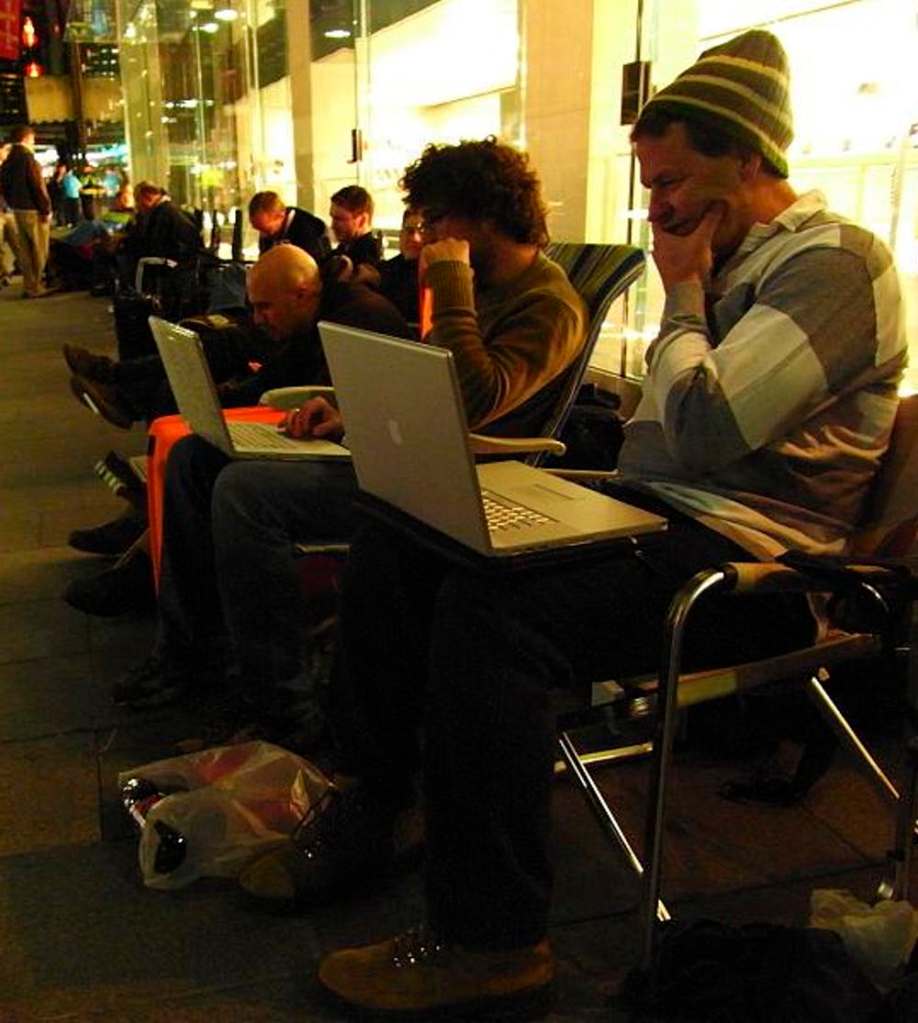
Image: ‘Customers queue outside Apples store overnight,’ http://theconversation.com/high-tech-consumerism-a-global-catastrophe-happening-on-our-watch-43476
Cramer discusses many areas of the digital world including its definition, exploring different interpretations of what is digital such as the official one but also his own and other scholars such as Cascone. “‘Digital’ simply means that something is divided into discrete, countable units – countable using whatever system one chooses” (Pg 8).
I read some of Cascone’s paper which also highlights the idea of the nostalgia of music and how the once new technological mediums such as “glitch, microwave, sincore” are now past, leading to a new post digital aesthetic. (Sited below)
-Cascone, K, 2006, MIT JOURNAL PRESS -“The Aesthetic of Failure: Post Digital Tendencies in Contemporary Computer Music’ https://www.mitpressjournals.org/doi/abs/10.1162/014892600559489?journalCode=comj
Post Digital seems to be too hard or too varied in interpretation in order to be adequately defined. Cramer takes into consideration many definitions and ideas, from the nostalgia of the past, just the rejects of the present or the combination of the chaos, disenchantment and sentiments that have risen due to this new age of technological innovation.
This is important knowledge that can help my in future with design with technology and these ideas discussed ever present in our world and this design field. The opinions of designers and scholars will help me understand the varying ideas of post digital and its impact on my life.
More Research(Week 8)
This talk about post digital brings highlighted the idea of how post modernism has impacted and influenced the modern artist. The directness of artists with their audience as well as how the audience has access to the artist is an interesting aspect, with artists no longer being a plaque on the wall but a contactable person. This idea of how the artist is now almost a public figure, exposed and no longer able to hide in their studio with the new communication technologies of today. “Today we are facing the constant demand for content” (2:15) Deylen states in his talk, and goes on to explain how this push for new content and the lack of rules with these new sources of income ‘iTunes’, ‘Spotify’, ‘YouTube’ etc are what has also driven this new consumerism. His brings us into the design in music field with the artist as the musician. It is interesting and important to understand the fields and impacts of design and their relationship with that of technology of old and new. The idea of post digital and digital media’s influence on my future designs is extremely important to know.
Christopher von Deylen, 2012, NEXT Conference, ‘The Post Digital Artist’, https://www.youtube.com/watch?v=RKnGlyt0ZzY
 Yeah Nah Nah Yeah